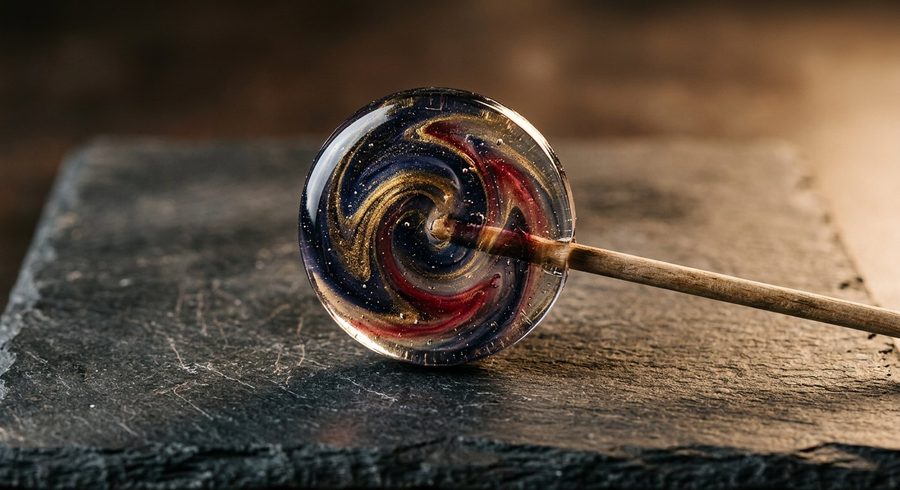
Every Saturday afternoon at our counter on West 28th Street in Minneapolis, we watch the same quiet comedy play out. We hand a visitor one of our deep midnight-indigo lollipops—The Solstice Orrery—without saying a word about its profile. Before the lollipop even reaches their lips, their eyes have already made a decision.
“Dark blackberry,” someone will say with complete certainty. Or, “Plum and dark currant.”
Then comes the first ten seconds on the tongue. Their eyebrows lift. They pause, look at the cosmic indigo-and-gold disc in their hand, and taste again. What they are experiencing isn't heavy dark berry at all—it is a brisk, sun-bright autumn orchard spark that gradually warms into toasted hearth caramel and a quiet twilight spice finish.
How Supermarket Color Coding Put Our Palates to Sleep
For nearly a century, mass-produced grocery store confectionery has relied on rigid visual shorthand. Bright red is always cherry or strawberry; neon green is always lime or sour apple; purple is always grape. When a wrapper prints the flavor name in bold letters on the front and matches it with a predictable dye, your brain takes a shortcut.
Instead of actively searching for nuances, your sensory cortex simply confirms what the label told it to expect. You unwrap the piece, register “cherry” for two seconds, and crunch through the rest without giving it a second thought.
What Happens During the First Ten Seconds
When you taste a hard confection without knowing its profile in advance, two distinct systems work together:
- Tongue-Tip Balance (Seconds 1–4): Your taste buds immediately gauge the balance between brisk tartness, kettle warmth, and subtle bitter-sweet depth.
- Retronasal Aroma (Seconds 5–15): As the warm surface of the lollipop begins to dissolve, gentle aromatic vapors travel up the back of the palate. This is where orchard, woodland, floral, and roasted hearth impressions live.
When your eyes see glacier teal (as in our Borealis Prism Drops), your brain braces for icy mint. When retronasal aroma instead delivers a woodland pine freshness that pivots into sun-ripened late-summer bramble, that contrast creates a moment of genuine delight.
Four Practical Tips for Tasting Unusual Confections at Home
Whether you are opening a box of our First-Bite Guessing Flight with friends or enjoying a single lollipop after dinner, try this simple four-step approach:
- Look at the Geometry First: Notice whether the piece is clear marble-cooled glass, pulled opaque satin, or a combination of both. Satin threads dissolve faster and release their aroma first.
- Exhale Gently Through Your Nose on the First Taste: Holding your breath mutes eighty percent of a confection’s complexity. A slow nasal exhale right as the candy warms on your tongue unlocks the opening note.
- Wait for the Mid-Palate Pivot: Because we layer multiple kettle pours into a single piece, the flavor at minute three is purposefully different from the flavor at second five.
- Write Your Guess Before Opening the Wax Seal: Once someone at the table says a specific fruit or spice out loud, everyone else’s brain will latch onto that word. Have everyone jot down two words silently before comparing notes!
Next Essay: How Humidity and Light Affect Hand-Pulled Confectionery →