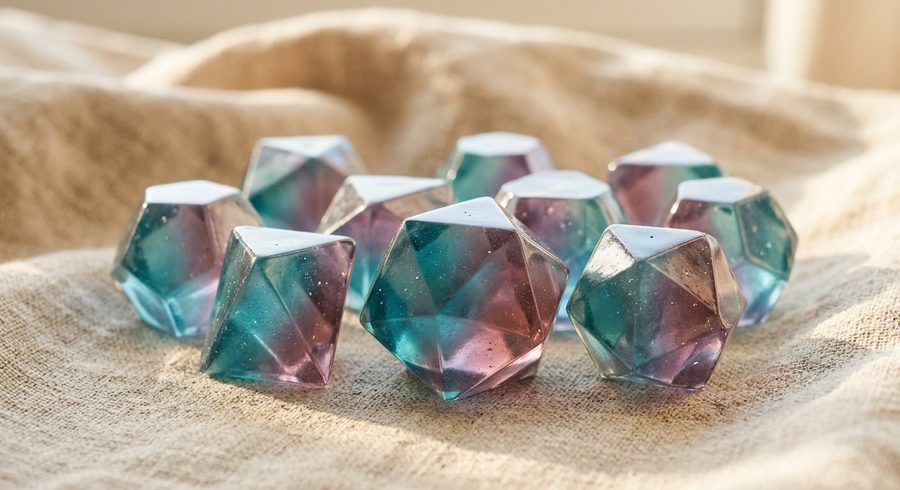
Living and working in Minneapolis gives a confectioner a deep respect for weather extremes. In January, the indoor air in our West 28th Street workshop is crisp and bone-dry—ideal conditions for pulling satin ribbons and shearing geometric facets that ring like crystal when tapped against the marble slab. In July, when thunderstorms roll over the lakes and relative humidity climbs past seventy percent, unprotected hard candy tries to drink moisture right out of the room.
Because small-batch artisan confectionery avoids industrial surface waxes and synthetic anti-caking coatings, knowing a few simple storage habits will keep your lollipops and prism drops looking like newly cut glass for months.
Why Hard Confectionery Is Actually a Delicate Glass
From a physics standpoint, a hand-poured lollipop is an amorphous solid—the exact same state of matter as window glass. When our kettle batch cools rapidly on the marble slab, its molecules lock into place without forming coarse grains. That is what gives our Solstice Orrery and Borealis Prism Drops their deep, jewel-like clarity.
However, that glass surface is naturally hygroscopic, meaning it attracts water molecules from humid air. If left unwrapped on a kitchen counter during a muggy summer week, microscopic moisture softens the outer micron of the piece, turning a mirror-bright facet slightly tacky or frosted.
The Three Pillars of Home Confectionery Storage
- Keep Individual Sleeves Sealed Until Serving: Every Copperfinch lollipop is sealed in a low-permeability wrapper within minutes of cooling in our dehumidified curing room. Leave that sleeve on until the moment you are ready to taste.
- Use Gasketed Glass Jars for Loose Drops & Ribbons: For creations like our Borealis Prism Drops or Midnight Nebula Ribbons, keep the lid of your glass jar or tin firmly closed between tastings. If you live in a coastal or humid summer climate, storing the closed jar inside a dark pantry cabinet adds a second buffer.
- Avoid Direct South-Facing Windowsills: While it is tempting to display our Vesper Amber Stained-Glass Flats in a sunny window because of how they catch the light, direct afternoon sun warms the core above 80°F (27°C), which can slowly soften sharp geometric edges over time.
Ideal Temperature & Shelf Life
Stored in a cool, dry cupboard between 60°F and 70°F (15°C–21°C) away from stove steam and direct sunlight, our poured lollipops and geometric drops maintain their crisp snap and vibrant three-stage flavor impressions for three to four months. Hand-pulled satin ribbons, which contain thousands of microscopic air channels, are best enjoyed within six to eight weeks of pouring while their delicate crunch is at its peak.
Next Essay: Hosting an Adult Tasting Flight With Coffee & Tea →